
Digital liquidity infrastructure
The financial system was never broken.
It simply was not designed for the digital world. For centuries, financial systems connected people with opportunity. Today, digital assets are creating a new global economy, yet one fundamental challenge remains: liquidity.
Money has evolved. Finance is still evolving. LiquidityOS is designed for the infrastructure layer underneath that movement.
Liquidity deployment model
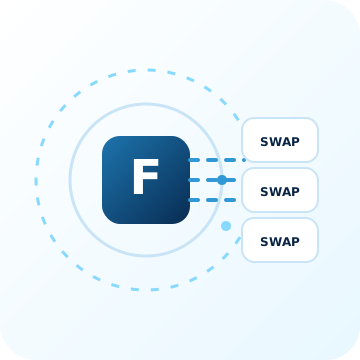
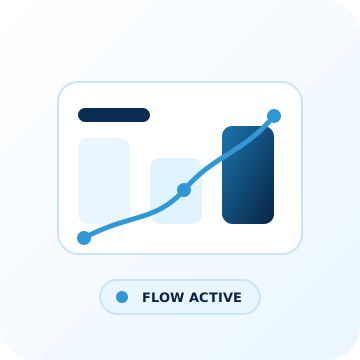
Capital moves through swap ecosystems and returns as reconciled revenue.
Flow active
✓ Connect fragmented liquidity
✓ Allocate through operating parameters
✓ Review performance by settlement cycle
Every Economy Runs on Movement.
Every modern economy depends on invisible infrastructure.
Cars move because roads exist. Electricity flows because power grids connect cities. Water reaches homes through pipelines. Information travels because of the internet. Digital assets are no different.
Behind every successful transaction lies one essential ingredient:
Liquidity.
Liquidity.
Trading costs increase.
Prices become less efficient.
Platforms struggle to scale.
User experience declines.
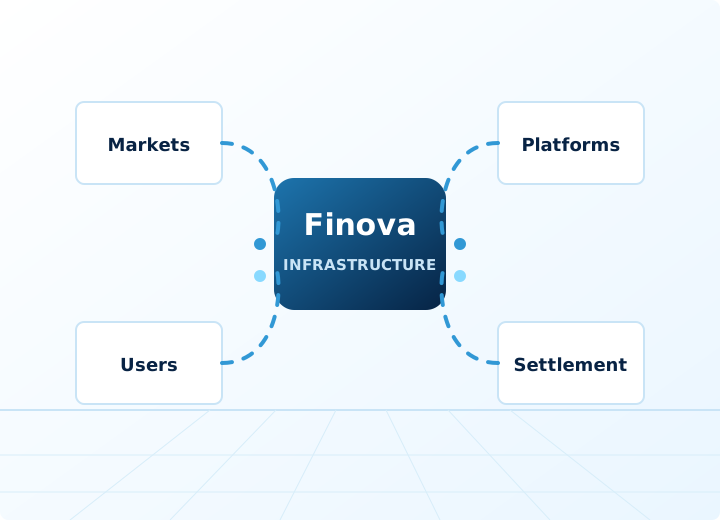
It needs infrastructure that connects them all.
Today, liquidity remains fragmented across countless exchanges, protocols and trading venues. Capital often sits where it isn't needed. Platforms continue searching for liquidity. Liquidity providers continue searching for efficient deployment.
The market doesn't simply need another exchange. It needs infrastructure that connects them all.
Introducing LiquidityOS™
Think of it as the traffic management system for digital liquidity.
LiquidityOS™ is Finova's proprietary liquidity operating framework. It doesn't replace roads. It helps traffic move more efficiently. It doesn't replace platforms. It helps liquidity reach where it is needed.
Its mission is simple.
We built LiquidityOS™ because the industry needed more than another opportunity. It needed a better operating system for liquidity.
Built Through Experience. Guided by Principles.
Built Through Experience. Guided by Principles.
LiquidityOS™ wasn't created overnight. It is the result of years of operational learning.
01
2024
Market Operations
02
Trading Strategies
03
Micro Lending Operations
04
LiquidityOS™
Every stage taught us something. We never chased trends. We followed lessons.
Today, every decision continues to be guided by four principles.
Transparency
Responsible Operations
Continuous Improvement
Long-Term Thinking
Because trust cannot be marketed. It must be earned.
How LiquidityOS™ Operates
How LiquidityOS™ Operates
Liquidity enters the ecosystem.
↓
LiquidityOS™ evaluates deployment opportunities.
↓
Liquidity is allocated according to operational parameters.
↓
Partner platforms facilitate transaction activity.
↓
Revenue is reconciled through scheduled settlement.
↓
Performance is reviewed.
↓
Member distributions follow the settlement cycle.
Why Weekly Settlement?
Real businesses don't stop every 24 hours. Neither should liquidity.
By allowing liquidity to remain active throughout the settlement period, partner platforms can continue supporting transaction activity before revenue is reconciled.
This approach prioritizes capital efficiency over payout frequency.
When operational performance is stronger, additional performance may be reflected in the weekly settlement, based on actual platform activity.
Looking beyond crypto
We are building infrastructure for the digital economy.
People often ask whether Finova is a crypto company. We believe the better question is: what kind of company are we building?
Is Finova a crypto company?
We believe the better question is what kind of company Finova is building. Finova is building infrastructure for the digital economy.
Why does liquidity infrastructure matter?
Just as cloud computing became essential to the internet, and payment networks became essential to global commerce, liquidity infrastructure can become essential to digital finance.
What does long-term success look like?
One day, millions of people may benefit from services powered by LiquidityOS™ without ever knowing its name. That is perfectly fine. The world's greatest infrastructure is rarely the most visible.
How should infrastructure be measured?
Its success is measured by how reliably it enables everything else to move.